Use AI marking
You can use artificial intelligence (AI) to automatically mark student work.
AI marking is most accurate for clear, straightforward question types, including multiple-choice and short-answer questions. It can also support the marking of worked-solution and extended-writing tasks at Key Stage 3. For the best results, check that each question has been cropped accurately and that no instructions, text, or answer space have been cut off. Also take time to check and adjust the grading criteria.
It should not be used for high-stakes assessments, and its use must always align with your school's assessment and AI policies.
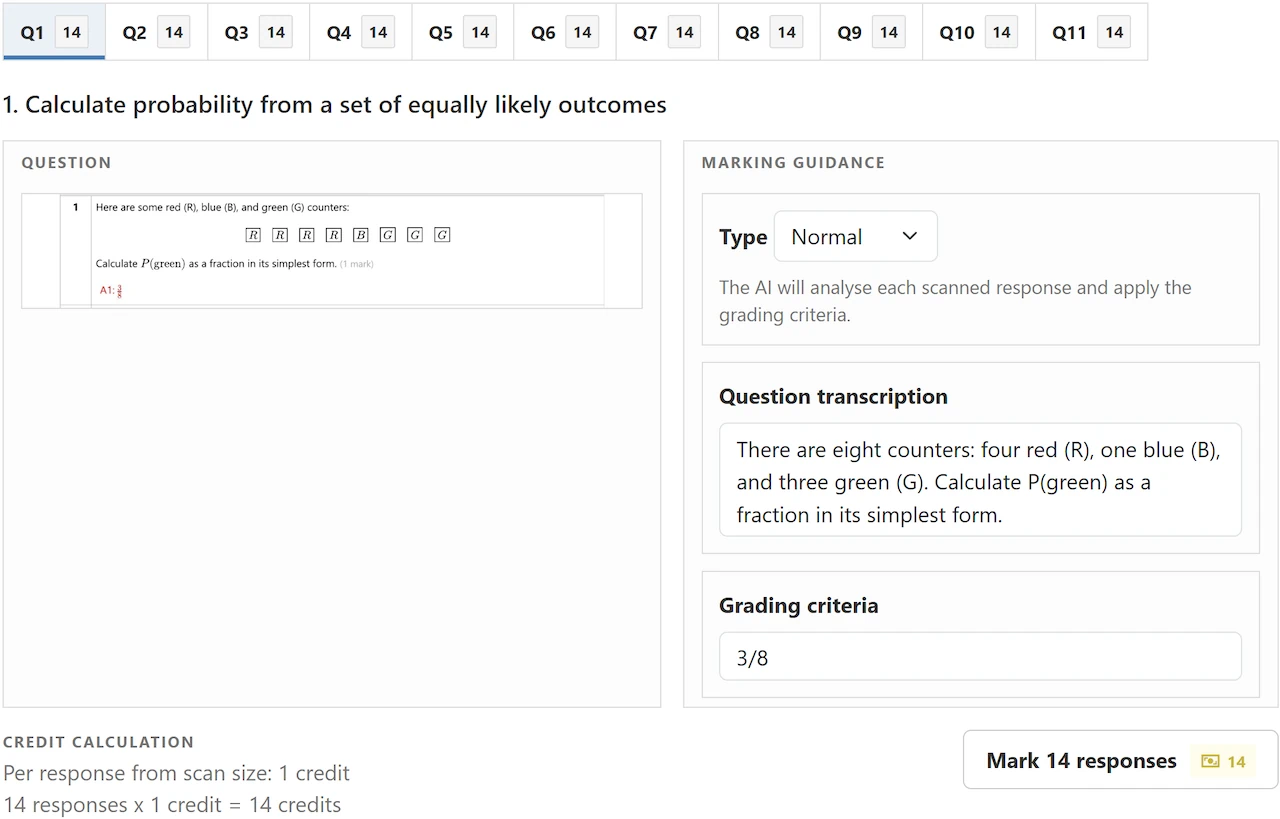
The feature is available when:
- your school administrator has enabled AI marking for your account;
- a blank copy of the test has been uploaded; and
- you have enough credits.
Marking modes
Four modes are available. MiniTest will automatically decide the best approach to use for each question, or you can decide manually.
- Normal — the AI model will be shown an image of the student's work with detailed marking instructions.
- MCQ — the AI model will receive a specialised prompt to determine which option(s) were indicated by the student.
- Transcribe — a first AI model will transcribe the student's work into plaintext, then a second AI model will mark it against the grading criteria.
- Skip — AI will not be used to mark this question.
AI credits
Using AI to automatically mark student work consumes credits.
Marking each answer has a base cost of 1 credit. For example, auto-marking a 10-question test for 20 students in Normal mode would typically consume 200 credits.
This base cost supports questions up to half a page in height. Each additional half-page, or part of that band, adds 1 extra credit, up to a maximum supported height of 2 pages. The transcribe option, which provides increased accuracy for extended-writing answers, costs an additional 1 credit per answer.
Marking multiple-choice questions costs one tenth of the standard rate.
The tariff is subject to change.
Your subscription includes 2,000 AI credits as a starting point, shared between all teachers. To purchase more, please email us to request an invoice. Credits expire 12 months after purchase and are non-refundable and non-transferable.
Reliability
AI doesn't always get things right, and it is your responsibility to review output for accuracy and appropriateness.
Pricing
You can purchase:
- 10,000 credits for £100
- 20,000 credits for £200
- 50,000 credits for £500
You may wish to discuss these pricing options with your senior leadership team. AI marking is an excellent investment in staff wellbeing, helping to reduce teachers' workload.
For example, in a secondary school, staff might use MiniTest to mark a total of 500,000 answers per year. A spend of £5,000 would remove this workload from all staff for the whole year.